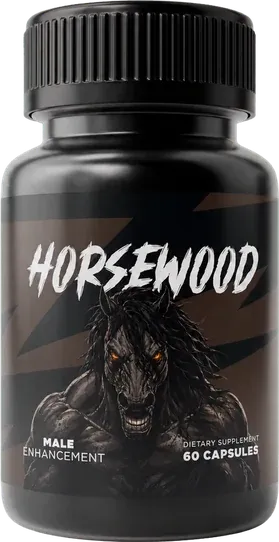
Horsewood Ingredients List: Seven Actives Read Line by Line for Beginners
The Horsewood ingredients list has seven actives per 2-capsule serving, 118 mg in total. Saw palmetto, wild yam, sarsaparilla, nettle leaf and boron chelate are 20 mg each. Tongkat ali is 10 mg of a 100:1 extract and horny goat weed is 8 mg of a 10:1 extract. Other ingredients are microcrystalline cellulose, gelatin and magnesium stearate. There is no proprietary blend, so every amount is printed.
How do you read a Supplement Facts panel if you have never done it?
A supplement label looks like a nutrition label, but it works differently. The top lines tell you the serving size. The middle lines list each active and its weight. The bottom lines list everything else.
On Horsewood the serving size is 2 capsules, and there are 30 servings in one 60-capsule bottle. Every weight on the panel is per serving, not per capsule. So the 20 mg of saw palmetto is the amount in two capsules together.
The dagger beside each line means 'Daily Value not established'. Herbs and plant extracts have no official daily target, so there is no percent to read. That is normal, not a gap.
Key facts
- Serving size: 2 capsules; 30 servings per container
- Seven actives, each with its own printed weight; total 118 mg
- Not a proprietary blend: no combined blend total on the label
- Other ingredients: microcrystalline cellulose, gelatin, magnesium stearate
- Label revision code REV 11/25 is not a lot number
- Not published: elemental boron, icariin content, expiry format
What are the seven Horsewood ingredients and their amounts?
| Ingredient | Plant or form | Per 2 capsules |
|---|---|---|
| Saw palmetto berry extract | Serenoa repens | 20 mg |
| Wild yam root extract | Dioscorea villosa | 20 mg |
| Sarsaparilla root extract | Smilax ornata | 20 mg |
| Nettle leaf extract | Urtica dioica | 20 mg |
| Boron amino acid chelate | Mineral bound to an amino acid; elemental boron not stated | 20 mg |
| Tongkat ali | Eurycoma longifolia, 100:1 extract | 10 mg |
| Horny goat weed | Epimedium sagittatum, 10:1 extract | 8 mg |
Add the weights: five lines at 20 mg make 100 mg, and 10 mg plus 8 mg makes 18 mg. The total is 118 mg of actives in a serving.
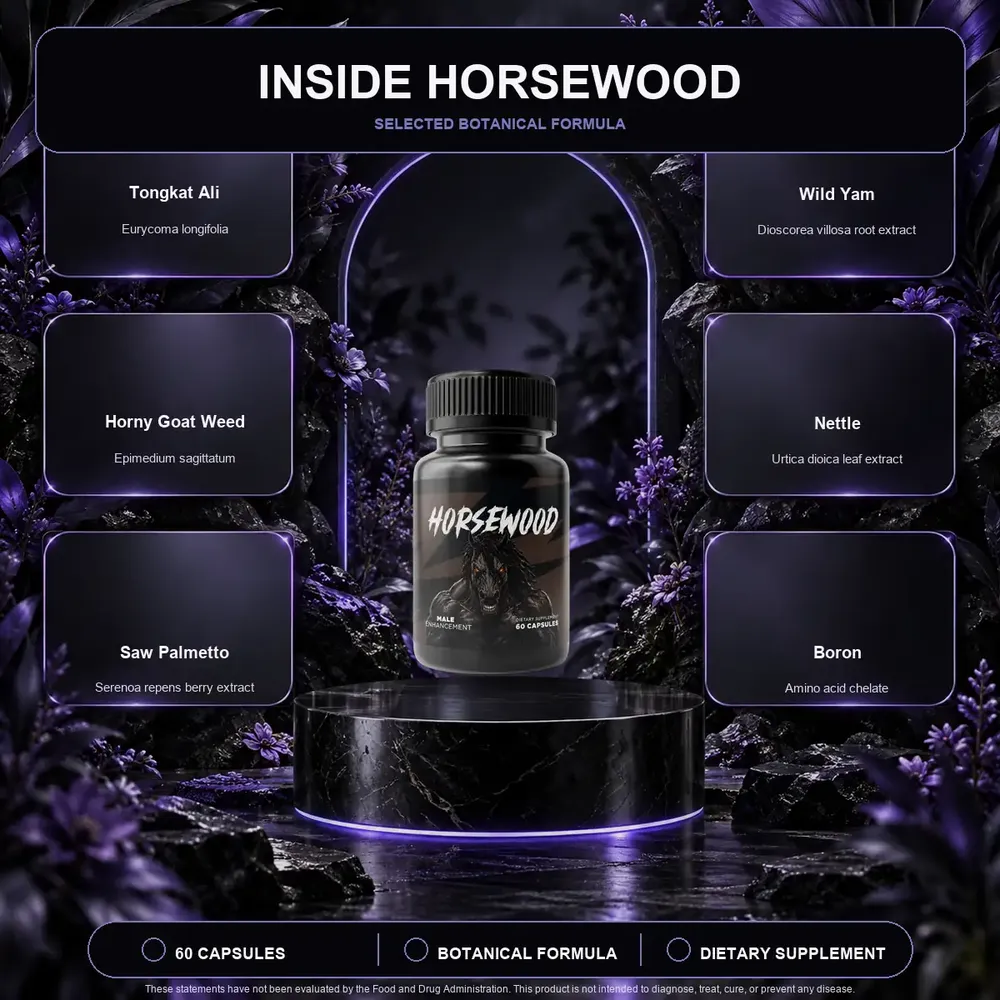
If you have seen a seller graphic with six ingredients, it leaves out sarsaparilla. The printed bottle panel lists seven, and when the two disagree the printed label is the one to trust.
What do the 100:1 and 10:1 notes mean on the label?
These numbers confuse nearly every new reader, so take them slowly. A ratio tells you how much raw plant went into making the extract. It does not tell you how much of any active compound is inside.
For tongkat ali the label says 100:1 and adds that 10 mg of extract equals about 1,000 mg of dry root powder. For horny goat weed it says 10:1, and 8 mg equals about 80 mg of dry herb.
| Label line | What you swallow | What the ratio adds |
|---|---|---|
| Tongkat ali, 100:1 | 10 mg of extract | Made from about 1,000 mg of dry root |
| Horny goat weed, 10:1 | 8 mg of extract | Made from about 80 mg of dry herb |
Here is why this matters. Human trials weigh the finished extract that people swallow. The tongkat ali studies gave 100 to 600 mg of extract a day (Leisegang et al., 2022). So the fair comparison is 10 mg against 100 mg or more, not 1,000 mg against anything. The bigger number describes the raw root, not your dose.
Is Horsewood a proprietary blend?
No. A proprietary blend lists a group of ingredients under one total weight and hides the split. Horsewood gives each of its seven actives its own milligram line, and there is no combined blend total on the label.
This is one of the label's best features. It lets you set every line beside a study dose, or beside another product's label. When you meet a product that says 'proprietary blend', ask which ingredient is the biggest and which is the smallest. On Horsewood you can already see it: the biggest are five at 20 mg, the smallest is horny goat weed at 8 mg.
What is in the capsule besides the actives?
Below the panel, the other ingredients are microcrystalline cellulose, gelatin and magnesium stearate. None of them is an active. Each has a simple job.
Microcrystalline cellulose
A plant fiber filler. It adds bulk so each capsule fills evenly.
Gelatin
The capsule shell. It is an animal product, so the capsule is not vegetarian. The label does not say which animal.
Magnesium stearate
A flow agent. It stops the powder from sticking to machines.
The label lists no sweetener, no flavor and no stimulant. If you avoid gelatin, skip this product. The sales page shows a vegetarian seal, but the label's gelatin line conflicts with it, and the label wins.
One more detail for people who search for gummies or drops. Horsewood is sold as capsules. This site knows of no gummy or drop form of the product.
What does the Horsewood label leave out?
A good reader notices what is missing as well as what is printed. Four details are not on the label.
- How much elemental boron sits inside the 20 mg of boron chelate. Boron has an adult upper limit of 20 mg of elemental boron a day from all sources (NIH ODS, 2022). A 20 mg chelate holds less than 20 mg of boron, but the exact share is not printed.
- How much icariin is in the horny goat weed extract.
- Any standardized marker compound for the tongkat ali extract.
- The animal source of the gelatin shell.
Also keep in mind that the lot reference HOR-26/HO-8071 and the CoA reference HOR-8071-26-HO used on this site are draft labels, not lab proof. No independent lab report has been published, so the printed amounts are the seller's figures.
Nettle is worth one more note. The label says nettle leaf. Prostate studies used nettle root, and the leaf is used for hay fever, so research on one does not carry over to the other (MSKCC, 2021).
How do you check the ingredients on your own bottle?
You can match a bottle to this page in about a minute. Hold the bottle and work through four steps.
Count seven lines
Look for saw palmetto, wild yam, sarsaparilla, nettle leaf, boron chelate, tongkat ali and horny goat weed.
Read the milligrams
Five lines read 20 mg. Tongkat ali reads 10 mg and horny goat weed reads 8 mg.
Check below the box
Find microcrystalline cellulose, gelatin and magnesium stearate, then the FDA statement and the facility line.
Check the seal
The label says not to use the bottle if the safety seal is damaged or missing.
If your bottle differs, do not take it. Photograph all three panels and call the order desk at +1 (302) 200-3480. For label reading in general, see our guide to comparing men's supplements.
Frequently asked questions
What are the ingredients in Horsewood?
Seven actives: saw palmetto, wild yam, sarsaparilla, nettle leaf and boron amino acid chelate at 20 mg each, tongkat ali at 10 mg and horny goat weed at 8 mg. Total 118 mg per serving.
Is Horsewood a proprietary blend?
No. Each of the seven actives has its own milligram line on the panel, and no combined blend total is printed.
Is 10 mg of tongkat ali the same as 1,000 mg?
No. The label says the 10 mg of extract came from about 1,000 mg of dry root powder. Human trials weighed the extract and used 100 to 600 mg a day.
Does Horsewood list icariin?
No. Horny goat weed appears as 8 mg of a 10:1 extract, and the icariin content is not stated on the label.
What are the other ingredients in Horsewood?
Microcrystalline cellulose, gelatin and magnesium stearate. The gelatin shell is an animal product, so the capsule is not vegetarian.
Does Horsewood come as gummies or drops?
This site knows only the capsule form: 60 capsules per bottle, 2 a day. The label reads Dietary Supplement, 60 Capsules.
Our view
Our view is that the Horsewood label is easy to read, which is rare in this category. Seven lines, seven weights, no blend and a short list of other ingredients.
The catch is in the numbers, not the layout. Most amounts are small beside the doses used in studies, and two key figures, elemental boron and icariin, are not printed. A beginner who learns to spot those two facts will read any men's label better.
Use the panel as your guide, not the slogans. Ask a doctor about any medicine you take. Horsewood is not FDA approved, and no supplement is.
Last updated
Keep reading: Horsewood Supplement Facts · Seven actives and their real amounts · Tongkat ali doses explained · Does boron raise testosterone?