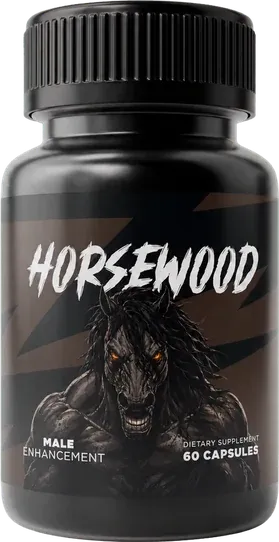
Horsewood Ingredients: Seven Actives and Their Real Amounts
Horsewood lists seven actives per 2-capsule serving, 118 mg in total. Saw palmetto, wild yam, sarsaparilla, nettle leaf and boron chelate come in at 20 mg each. Tongkat ali is 10 mg and horny goat weed 8 mg. Human studies used far more: 100 to 600 mg of tongkat ali and 320 mg of saw palmetto.
What are the seven Horsewood ingredients?
Horsewood lists seven active ingredients in each 2-capsule serving. Five are herbs or a mineral at 20 mg each. Tongkat ali comes in at 10 mg and horny goat weed at 8 mg.
Every amount is printed, which many men's formulas skip. The total is 118 mg of actives per day. The table gives each name as it reads on the bottle.
| Ingredient | Plant or form | Amount per 2 capsules |
|---|---|---|
| Saw palmetto berry extract | Serenoa repens | 20 mg |
| Wild yam root extract | Dioscorea villosa | 20 mg |
| Sarsaparilla root extract | Smilax ornata | 20 mg |
| Nettle leaf extract | Urtica dioica | 20 mg |
| Boron amino acid chelate | Mineral bound to an amino acid | 20 mg |
| Tongkat ali | Eurycoma longifolia, 100:1 extract | 10 mg |
| Horny goat weed | Epimedium sagittatum, 10:1 extract | 8 mg |
Tongkat ali in Horsewood: 10 mg of a 100:1 extract
Tongkat ali is the Horsewood ingredient with the most human research. It is the root of a Southeast Asian shrub. Trials tie it to higher testosterone, mostly in men who start with low levels.
The label gives 10 mg of a 100:1 extract. It adds that this equals about 1,000 mg of dry root powder.
What the tongkat ali research found
- A review of trials found total testosterone rose, mainly in men with low starting levels. Doses ran from 100 to 600 mg a day (Leisegang et al., 2022).
- In 105 men aged 50 to 70, 100 or 200 mg a day raised testosterone in those who started low. At 100 mg the change took 12 weeks (Chinnappan et al., 2021).
- In 63 moderately stressed adults, 200 mg a day for four weeks lowered cortisol and lifted some mood scores (Talbott et al., 2013).
More on this is in the post on tongkat ali doses.
Horny goat weed in Horsewood: 8 mg, icariin not stated
Horny goat weed is the common name for epimedium, a leafy plant from Asia. Horsewood lists 8 mg of a 10:1 extract, which the label says equals about 80 mg of dry herb. Its best-known compound is icariin.
Most of the research on icariin comes from animals. People have only been studied for safety and absorption.
- Icariin improved erections in rats with nerve injury, at 1 to 10 mg per kg a day (Shindel et al., 2010).
- In a five-day human study, 100 to 1,680 mg of icariin a day was barely absorbed. The top dose upset some stomachs (Brown et al., 2019).
- Memorial Sloan Kettering calls a sexual-function benefit unproven (MSKCC, 2023).
Saw palmetto in Horsewood: a prostate herb at 20 mg
Saw palmetto berry extract is in Horsewood at 20 mg. The berry comes from a small palm that grows in the southeastern US. Research looks at it for urinary symptoms in older men, not for desire or male response.
Even at full dose, the urinary results were weak.
- A Cochrane review of 27 trials and 4,656 men found little to no benefit for urinary symptoms (Franco et al., 2023).
- In a 72-week trial, raising the dose from 320 mg to 960 mg a day did no better than placebo (Barry et al., 2011).
- The US health agency NCCIH calls it generally well tolerated (NCCIH, 2025).
Wild yam and sarsaparilla in Horsewood: traditional roots
Wild yam and sarsaparilla are two roots with a long folk history. Horsewood lists 20 mg of each. Neither has human research for men's health.
Wild yam contains diosgenin, a plant compound labs can use to make hormones. The body cannot do that conversion on its own.
Wild yam root
- Memorial Sloan Kettering states there is no evidence the body turns diosgenin into hormones (MSKCC, 2022).
- In 23 women, a wild yam cream for three months did not change hormone levels (Komesaroff et al., 2001).
Sarsaparilla root
- Clinical data are so limited that sarsaparilla cannot be recommended for any use (Drugs.com, 2026).
- Some seller graphics leave it out, but the panel on the bottle lists it.
Nettle leaf and boron in Horsewood: leaf and mineral
Horsewood lists 20 mg of nettle leaf extract and 20 mg of boron amino acid chelate. The nettle is leaf, not root. The boron line gives the weight of the chelate, not the boron inside it.
Both details change how the research applies.
Nettle leaf
- Prostate studies used nettle root, and there is no sexual-function evidence (MSKCC, 2021).
- Nettle leaf is used for hay fever, and typical amounts run 300 to 600 mg a day (LiverTox, 2023).
- Even for allergies, NCCIH calls the evidence inconsistent or too limited (NCCIH, 2019).
Boron amino acid chelate
- US adults get about 1 mg of boron a day from food. The upper limit is 20 mg of elemental boron a day (NIH ODS, 2022).
- In 8 men, 10 mg of boron a day for one week raised free testosterone. The study was tiny and had no placebo group (Naghii et al., 2011).
The full story is in does boron raise testosterone.
Horsewood doses vs research doses: the honest table
Every Horsewood dose sits well below the amounts used in human studies. Tongkat ali is one-tenth of the lowest dose that worked. Saw palmetto is one-sixteenth of the standard dose.
The meter uses a log scale, so each step to the right is ten times more. The dot is the Horsewood amount and the band is the research range.
Horsewood's 10 mg is one-tenth of the lowest dose that worked. Sources: (Chinnappan et al., 2021) (Leisegang et al., 2022)
Even the standard dose showed no benefit for urinary symptoms. Sources: (Barry et al., 2011)
Leaf is studied for allergies, not men's health. Sources: (LiverTox, 2023)
The label gives 20 mg of chelate, not the elemental boron inside it. Sources: (Naghii et al., 2011) (NIH ODS, 2022)
Icariin content of the 8 mg extract is not stated. Sources: (Brown et al., 2019)
No human evidence supports either for men's health. Sources: (MSKCC, 2022) (Drugs.com, 2026)
Horsewood amount (when published) dose range used in human studies (log scale)
| Ingredient | Horsewood per day | Research dose | Gap |
|---|---|---|---|
| Tongkat ali extract | 10 mg | 100 to 600 mg | 10 to 60 times smaller |
| Saw palmetto | 20 mg | 320 mg standard | 16 times smaller |
| Nettle leaf | 20 mg | 300 to 600 mg | 15 to 30 times smaller |
| Boron (elemental) | Not stated | 10 mg in one small study | Cannot compare |
| Horny goat weed | 8 mg extract | Icariin in mg, safety study only | Icariin not stated |
| Wild yam | 20 mg | No oral dose for men | No benchmark |
| Sarsaparilla | 20 mg | No human dose | No benchmark |
No study has tested the Horsewood formula itself. The effects above belong to single ingredients at larger doses.
What do the Horsewood ingredients look like before they are capsuled?
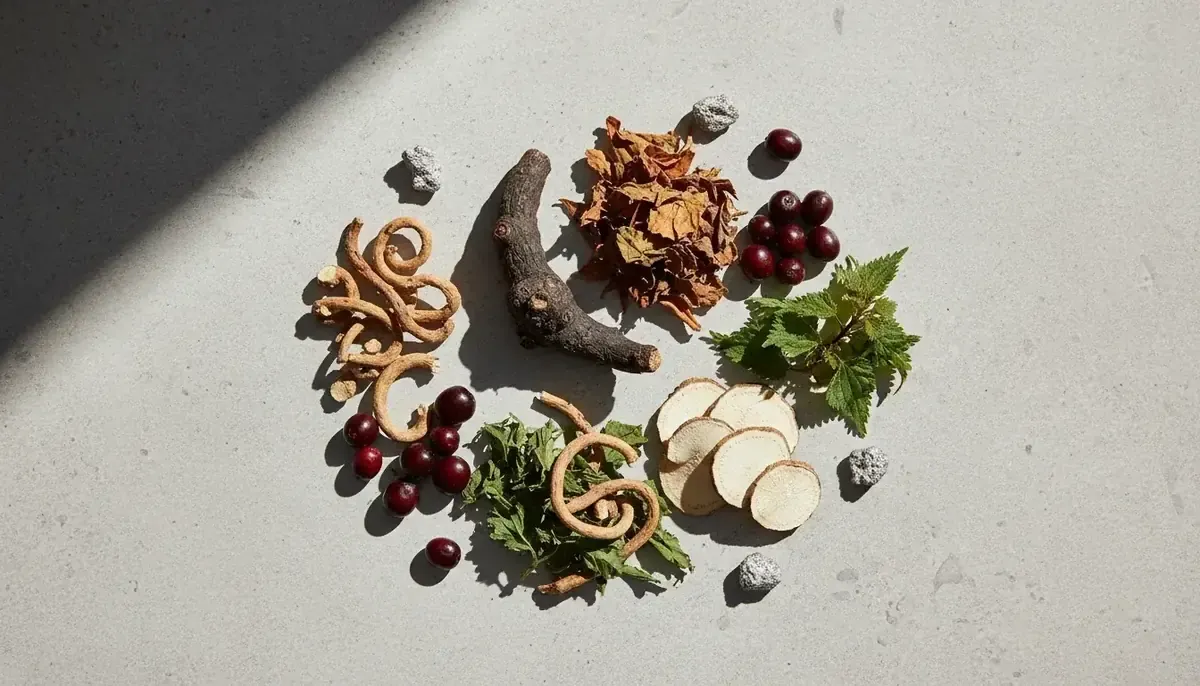
The Horsewood actives start as berries, roots, leaves and a mineral. Makers dry and extract them into powders before they go into gelatin capsules.
An extract ratio such as 100:1 tells you how much raw plant went into each part of powder. It does not tell you how much of any active compound the powder holds.
The full label, line by line, is on the supplement facts page.
How to check the Horsewood ingredients on your own bottle
You can match your Horsewood bottle to this page in about a minute. The Supplement Facts box sits on the right side of the label.
Count seven lines
Look for saw palmetto, wild yam, sarsaparilla, nettle leaf, boron chelate, tongkat ali and horny goat weed.
Read the milligrams
Five lines read 20 mg. Tongkat ali reads 10 mg and horny goat weed reads 8 mg.
Check other ingredients
Below the box: microcrystalline cellulose, gelatin and magnesium stearate.
If you plan to take it, the side effects page covers possible reactions. The how it works page links each claim to an ingredient.
Horsewood ingredients: common questions
How many active ingredients are in Horsewood?
The label lists seven actives per 2-capsule serving. Five come in at 20 mg each, tongkat ali at 10 mg and horny goat weed at 8 mg, for 118 mg in total.
Why does the Horsewood graphic show six ingredients when the label shows seven?
The seller's graphic leaves out sarsaparilla root. The Supplement Facts panel on the bottle includes it at 20 mg. When the two disagree, the printed label is the one to trust.
Is 10 mg of tongkat ali in Horsewood the same as 1,000 mg?
No. The label says the 10 mg came from about 1,000 mg of dry root powder. Human trials weighed the finished extract and used 100 to 600 mg of it a day.
How much elemental boron is in Horsewood?
The label does not say. It lists 20 mg of boron amino acid chelate, which is boron bound to an amino acid. The boron share of that weight is not printed.
Does Horsewood list icariin?
No. Horny goat weed appears as 8 mg of a 10:1 extract, and the icariin content is not stated on the label.
Is nettle in Horsewood the same nettle used in prostate studies?
No. The label lists nettle leaf. Prostate studies mostly used nettle root, while the leaf is studied for hay fever.