Tongkat Ali Doses Explained: Extract Ratios vs. Real Milligrams
A 100:1 ratio means about 100 parts of root made 1 part of extract. Horsewood holds 10 mg of that extract per serving, which the label equates to about 1,000 mg of dry root. Studies weighed the extract itself and used 100 to 600 mg a day, so Horsewood’s real amount is one-tenth of the lowest studied dose.
What does a tongkat ali extract ratio like 100:1 mean?
An extract ratio tells you how much raw plant went into the powder. A 100:1 ratio means about 100 grams of dried root were used to make 1 gram of extract.
Makers soak the root in water or another solvent, then dry what comes out. The leftover powder is smaller and more concentrated. The ratio is the maker’s own record of that shrink.
What a ratio does not tell you
- How much of the active plant compounds the extract holds
- Which solvent or method the maker used
- Whether the extract matches the one used in a study
- How your body will respond to it
Think of a ratio as a recipe note, not a strength rating. Two extracts can share the same ratio and still differ a lot.
How much tongkat ali is in Horsewood, in real milligrams?
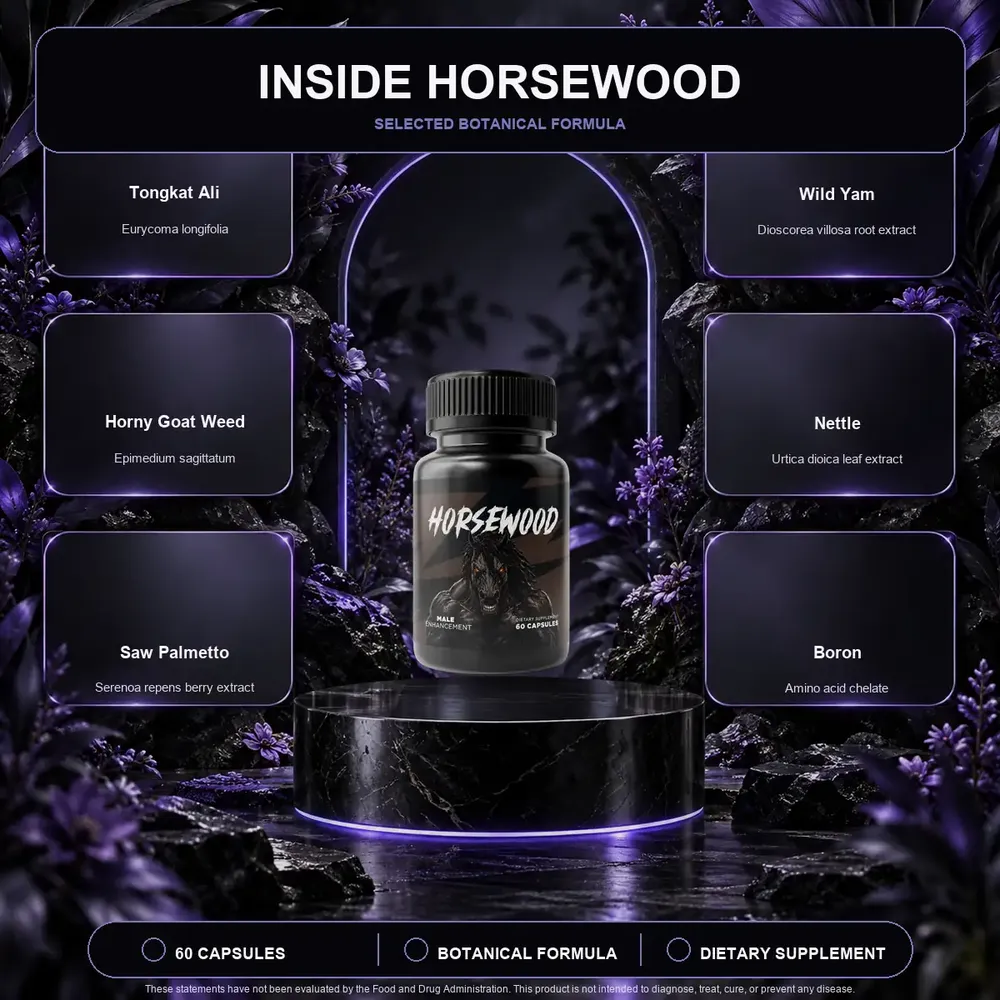
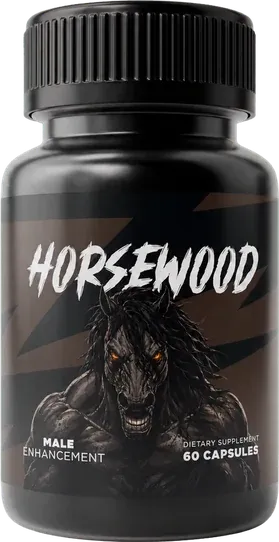
Horsewood holds 10 mg of tongkat ali extract in each 2-capsule serving. That is the real weight of powder you swallow.
The label adds a second number. It says the 10 mg comes from a 100:1 extract, equal to about 1,000 mg of dry tongkat ali powder.
The math behind the label
- Start with the real amount: 10 mg of extract.
- Read the ratio: 100 parts root to 1 part extract.
- Multiply: 10 mg times 100 equals 1,000 mg of raw root.
- Keep the real number: you still swallow 10 mg of extract.
Both numbers are honest. They just answer different questions. The 1,000 mg figure is how much root the maker says was used. The 10 mg figure is what ends up in the Horsewood Supplement Facts panel as the serving amount.
Why can’t a dry-powder equivalent be compared with trial doses?
Trials weigh the extract people took, not the root that went into it. So a 1,000 mg equivalent has to be set against real extract doses, not against 1,000 mg of anything.
One trial in men aged 50 to 70 used a standardised water extract of the root (Chinnappan et al., 2021). Standardised means the maker tested the extract for set levels of key compounds. The dose was the weight of that tested extract.
Horsewood’s label gives a ratio, not a standard. It does not say which compounds were measured, or at what level. That makes a clean match with any trial impossible.
What tongkat ali doses did the studies use, next to Horsewood?
The studies used 100 to 600 mg of tongkat ali extract a day. A review of the testosterone trials covered that full range (Leisegang et al., 2022).
The table lines up the three sources in this post with the real amount in one serving of the product.
| Source | Daily extract dose | Length | Who took part |
|---|---|---|---|
| Leisegang et al., 2022 (review) | 100 to 600 mg | Varied by trial | Men in several pooled trials |
| Chinnappan et al., 2021 | 100 or 200 mg | 12 weeks | 105 men aged 50 to 70 |
| Talbott et al., 2013 | 200 mg | 4 weeks | 63 moderately stressed adults |
| Horsewood (label) | 10 mg | No timeline on the label | Not tested as a product |
Read the last row with care. The studies tested single tongkat ali extracts. None of them tested a blend like this one.
Every amount in Horsewood is on the label
Two capsules a day, 60 per bottle, 10 mg of tongkat ali extract and a 60-day money-back window. Questions first? Call +1 (302) 200-3480.
How does Horsewood’s 10 mg compare with the lowest studied dose?
Horsewood’s 10 mg is one-tenth of the lowest dose in these studies. It is one-twentieth of 200 mg and one-sixtieth of 600 mg.
Put another way, the lowest trial dose was 10 times larger than one full serving.
That gap does not prove the product does nothing. It means the trials cannot vouch for this amount. No one has studied tongkat ali at 10 mg a day and reported the result.
Do not try to close the gap by taking extra capsules. The label says not to exceed 2 capsules a day, and it holds six other herbs too.
What did the tongkat ali studies actually find?
The studies found a testosterone rise mainly in men who started with low levels. Men with normal levels saw much less change.
The review reached that view across its pooled trials (Leisegang et al., 2022). The trial in older men found the same pattern, and the 100 mg group needed 12 weeks to show it (Chinnappan et al., 2021).
The stress trial
A smaller trial looked at stress instead. Adults who took 200 mg a day for 4 weeks had lower cortisol, a stress hormone, and some better mood scores (Talbott et al., 2013). It was a small study and needs repeating.
What Horsewood itself claims
Horsewood’s label claims do not mention testosterone. They cover blood flow and male response, libido and desire, and mental clarity. So the testosterone trials are background on one herb, not proof for the product.
How to check the tongkat ali dose on any label
Find the extract weight, then compare it with 100 to 600 mg. Those two steps sort most labels in under a minute.
Find the milligrams
Look for tongkat ali or Eurycoma longifolia on the Supplement Facts panel, with a weight next to it.
Spot the ratio
Note any ratio such as 50:1 or 100:1, and any dry-powder equivalent printed below it.
Compare the real weight
Set the extract weight, not the equivalent, against the 100 to 600 mg used in studies.
Check for a standard
See if the label names a tested compound level. Most blends, including this one, do not.
Labels hide other traps too, such as blends with no amounts. Our guide on how to read a men’s supplement label covers them one by one.
Is the tongkat ali in Horsewood safe to take?
The tongkat ali trials in this post lasted 4 to 12 weeks, so they say little about longer use. With Horsewood, the whole blend of seven ingredients matters more than the 10 mg of tongkat ali.
Horny goat weed, for example, has heart-rhythm case reports and drug interactions (MSKCC, 2023).
The Horsewood side effects page covers each ingredient. Boron is the other herb-aisle favorite linked to testosterone; our post asking does boron raise testosterone? looks at that evidence. For all seven amounts in one place, see the Horsewood ingredients page.
Tongkat ali doses: common questions
What does 100:1 mean on a tongkat ali label?
It means about 100 parts of dried root went in to make 1 part of extract. It tells you how concentrated the maker says the powder is, not how strong it is in your body.
How much tongkat ali is in Horsewood?
Each 2-capsule serving of Horsewood holds 10 mg of a 100:1 tongkat ali extract. The label says that equals about 1,000 mg of dry root powder.
How much tongkat ali did the studies use?
The human studies in this post used 100 to 600 mg of extract a day. The most common amounts were 100 mg and 200 mg.
Is 1,000 mg of dry-powder equivalent the same as 1,000 mg of extract?
No. The 1,000 mg figure describes the raw root used to make 10 mg of extract. The trials weighed the extract itself, so the two numbers measure different things.
Can I take more Horsewood capsules to reach a study dose?
No. The label says not to exceed the recommended dose of 2 capsules a day. Talk to your doctor if you want a different amount of any herb.
How long did the tongkat ali trials last?
They ran from 4 weeks to 12 weeks. In one trial of men aged 50 to 70, the 100 mg dose took 12 weeks to show a change.