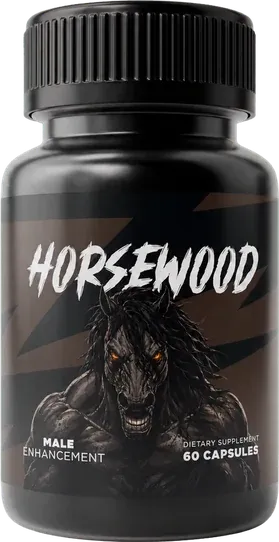
How to Read a Men's Supplement Label: Amounts, Ratios and Red Flags
Start with the serving size, then check that every active has its own weight. Compare extract weights, not dry-powder equivalents, with research doses. Support claims need an asterisk and the FDA disclaimer. FDA does not approve supplements. Horsewood lists all seven amounts, 118 mg in total, but they are small next to studies.
What are the main parts of a men’s supplement label?
A supplement label has five main parts: the Supplement Facts panel, other ingredients, directions, cautions and claims. Each part answers a different question about the bottle.
Most buyers only read the front. The back is where the useful facts live.
| Label part | What it tells you | What to check |
|---|---|---|
| Supplement Facts panel | Each active ingredient and its amount | A weight for every ingredient |
| Other ingredients | Capsule shell, fillers and flow agents | Gelatin, allergens or dyes you avoid |
| Suggested use | How many capsules and how often | The serving matches the panel |
| Caution and warnings | Who should ask a doctor first | Clear, specific wording |
| Claims and disclaimer | What the maker says the product supports | An asterisk and the FDA disclaimer |
How to read serving size on a label like Horsewood’s
Read the serving size before any amount. Every number on the panel is per serving, not per capsule.
On the Horsewood label, a serving is 2 capsules and there are 30 servings in a 60-capsule bottle. So the 20 mg of saw palmetto is split across 2 capsules, about 10 mg in each.
The Daily Value column
The % Daily Value column shows how much of a set daily target a serving gives. Vitamins and some minerals have one. Most herbs do not, so they get a dagger (†) that means no Daily Value has been set.
Every active on the Horsewood panel carries that dagger. It is normal for an herbal blend.
What do extract ratios like Horsewood’s 10:1 mean on a label?
An extract ratio says how much raw plant went into the powder. An “equivalent to” line multiplies the real weight by that ratio.
Horsewood’s horny goat weed is 8 mg of a 10:1 extract. The label says that equals about 80 mg of dry powder. You still swallow 8 mg.
The bigger number sounds better, but studies weigh the extract itself. So compare the real weight with research doses, and set the equivalent aside.
Our post on tongkat ali doses explained works through the same math for the 10 mg of tongkat ali in Horsewood.
What is a proprietary blend, and why does it matter?
A proprietary blend lists several ingredients under one total weight. You see the names but not how much of each one is inside.
That makes it impossible to compare any single ingredient with research. A blend of 500 mg could be mostly one cheap herb and a pinch of the rest.
How the Horsewood label handles it
Horsewood does not use a proprietary blend. Each of its seven actives has its own weight, from 8 mg to 20 mg. That openness lets you see that the amounts are small, which is useful to know before you buy.
- Every active named with its own weight
- Total of 118 mg of actives per serving
- Extract ratios printed for tongkat ali and horny goat weed
What do the claims and the asterisk on a label mean?
Claims on a supplement label describe support for a body function, not a cure. FDA calls these structure/function claims, and they are not approved in advance (FDA, 2024).
Any such claim must carry an asterisk and a disclaimer. The disclaimer says FDA has not evaluated the statement and the product is not meant to diagnose, treat, cure or prevent disease.
| Claim type | Example wording | Allowed on a supplement? |
|---|---|---|
| Structure/function | Supports healthy blood flow | Yes, with the FDA disclaimer |
| Disease claim | Treats erectile dysfunction | No |
| Approval claim | FDA approved formula | No |
| Performance slogan | Promises about stamina or size | Not a structure/function claim |
Horsewood’s label claims fit the first row: blood flow and male response, libido and desire, and mental clarity. Its sales page also uses performance slogans. Those are not structure/function claims, and this site does not repeat them.
Read the full Horsewood label, then decide
Seven actives with every amount printed, 2 capsules a day and a 60-day money-back window. Questions? Call +1 (302) 200-3480.
Does “FDA registered” on the Horsewood label mean FDA approved?
No. FDA does not approve dietary supplements, and a registered facility is not an approved product (FDA, 2026).
Registration means the factory has told FDA it exists and what it makes. It says nothing about whether a formula works.
The Horsewood label says the product was made in an FDA-registered facility. That line describes the factory. It is a fair statement, as long as no one turns it into “FDA approved.”
Logos work the same way. A famous name on a sales page shows where research can be found, not that the group backs the product.
Worked example: reading the Horsewood label line by line
Here is the Horsewood label read with the same checks. It scores well on openness and poorly on dose size.
Tap the numbered dots on the label to read each part.
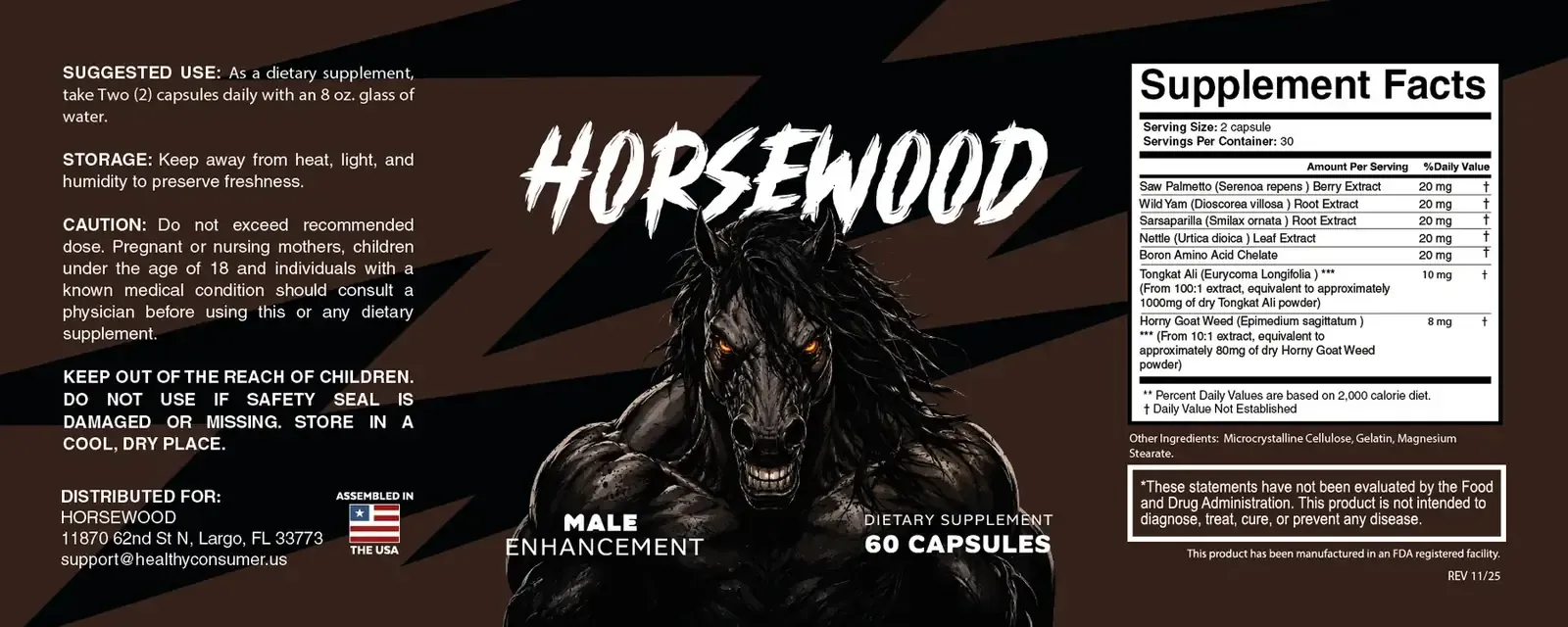
| Label line | What it says | What it tells you |
|---|---|---|
| Serving size | 2 capsules, 30 servings | A 30-day supply per bottle |
| Five actives at 20 mg | Saw palmetto, wild yam, sarsaparilla, nettle leaf, boron chelate | Small next to research; saw palmetto studies used 320 mg |
| Tongkat ali | 10 mg of 100:1 extract, about 1,000 mg dry equivalent | One-tenth of the lowest studied dose |
| Horny goat weed | 8 mg of 10:1 extract, about 80 mg dry equivalent | Icariin content not stated |
| Boron chelate | 20 mg | Elemental boron not stated |
| Other ingredients | Microcrystalline cellulose, gelatin, magnesium stearate | Gelatin shell, so not vegetarian |
| Made | Assembled in the USA; FDA-registered facility | Describes the factory, not approval |
| Distributor | Horsewood, Largo, FL | A named US business on the bottle |
Our post on whether boron raises testosterone explains why the missing elemental figure matters. The Horsewood Supplement Facts page shows the panel as plain text.
What red flags should you watch for on a men’s supplement label?
The biggest red flag is a men’s product that works too fast or too well. FDA has found hidden prescription drugs in many sexual-enhancement products, and its list covers only a fraction (FDA, 2026).
NCCIH gives the same warning for this product type (NCCIH, 2019). That is a category risk, not a finding about any one brand.
- No amount given for any ingredient
- “FDA approved” on a supplement
- Claims to treat or cure a condition
- Promises of results within minutes or hours
- No named company or US address on the bottle
A 60-second label check for Horsewood or any men’s supplement
Five quick checks sort most men’s supplement labels. Do them in order, and stop at the first one that fails.
Find every amount
Each active should have its own weight. A blend with one total hides the doses.
Use the real weight
Compare extract weights, not dry equivalents, with research doses.
Read the claims
Support claims with an asterisk are normal. Cure or approval claims are not.
Check who made it
Look for a named distributor, a US address and a phone number.
Ask about your medicines
Show the label to your doctor or pharmacist if you take any prescription.
Horsewood passes the first, third and fourth checks. The second check shows how small its amounts are. The Horsewood ingredients page sets each one against research.
Reading supplement labels: common questions
Are the amounts on a supplement label per capsule or per serving?
Per serving. Check the serving size line first. If a serving is 2 capsules, each capsule holds about half of each listed amount.
What does the dagger symbol mean on a Supplement Facts panel?
It means no Daily Value has been set for that ingredient. Most herbs carry a dagger, because there is no official daily need for them.
Does FDA approve dietary supplements?
No. FDA does not approve dietary supplements before they are sold. A label that says “FDA approved” is a red flag.
What does “made in an FDA-registered facility” mean?
It means the factory is registered with FDA. It describes the building, not the product, and it is not an approval.
Why do men’s supplements carry a hidden-drug warning?
FDA has found hidden prescription drugs in many sexual-enhancement products. Its warning list covers only a fraction of them, so buyers need to read labels with care.
Does the Horsewood label list every amount?
Yes. The Horsewood panel lists all seven actives with a weight for each, 118 mg in total per 2-capsule serving. It does not state elemental boron or icariin content.